



Experience Rato Machindranath Jatra, Nepal’s longest festival. Explore the legend, the giant chariot of Patan, Bhoto Jatra, and homestays in Bungamati.
Rato Machindranath Jatra is one of the most celebrated jatras of Kathmandu and is celebrated to pay homage to the God of rain and good harvest, Rato Machindranath. The month-long festival also known as Bunga Dyah is a great festivity in Newar communities. The jatra to honor Rato Machindranath starts with chariot procession from Patan and ends with Bhoto Jatra in Jawalakhel. The chariot march begins after four days of the chariot building. The chariot for the festival is built in Pulchowk and pulled all the way to Ganabahal with the hollering of “Haste and Haste’.” The procession is eventful, with music and dance played. The chariot is then processed to Sundhara and then to Lagankhel. During the chariot procession in Lagankhel, women of all ages participate in pulling the chariot. The festival ends with Bhoto Jatra after the chariot is taken to Jawalakhel. However, unlike other days, the procession to Jawalakhel requires an auspicious day with consultation with the priest and astrologer. Waiting for the auspicious date can take at least a month, making the festival the longest in the country. The festival is concluded with Bhoto Jatra in Jawalakhel, and the Rato Machindranath is then taken in Bungamati, where the god will stay for 6 months.
Our reach to the internet has made every possible information easily accessible. Finding stories of Rato Machindranath, its significance, and how it's celebrated is relatively easy. However, living the festival and learning about it while being observed in a local setting elevates the whole experience.
Tales of Rato Machindranath grants you an immersive opportunity to live the celebration while touring around both homes of Rato Machindranath: Patan, and Bungamati, all the while listening to the legends behind the Rato Machindranath and also witnessing the mighty chariot of Rato Machindranath being dragged down by the alleys of Patan.
You can be part of the longest-running festival of the valley trailing behind the path of Rato Machindranath from Bungamti to Patan and immerse yourself in the unique celebration of the valley.
Rato Machindranath in Community Homestay:
Bungamati
Bungamati, home to the Lord Rato Machindranath for 6 months, has their special way of preparation before the beginning of the jatra. An unique ritual is performed in Katuwal Daha recreating the moment when Rato Machindranath was first welcomed in Bungamati.
The statue of the lord which is taken to Patan during November/December is brought back to Bungamati after the completion of the jatra where it stays for another six months.
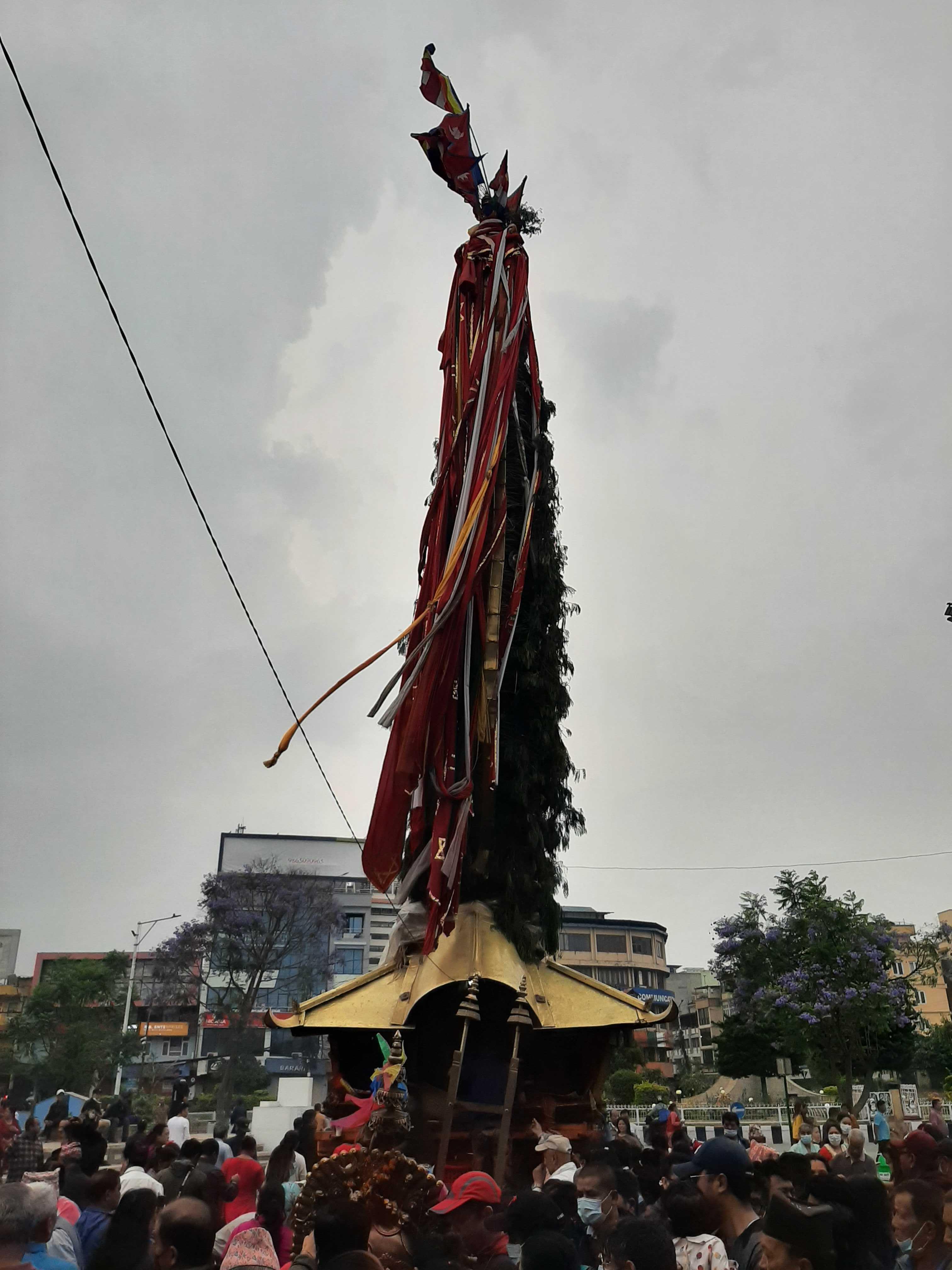
The second home of the Rato Machindranath, Patan, hosts the longest festival of the nation: Rato Machindranath Jatra. The festival is held during May-June and celebrated with the hauling of an enormous chariot with massive wheels and gigantic pine-like structure.
The chariot which shelters Rato Machindranath for the duration of jatra is dragged through various stopovers accompanied by traditional music players.
The vibrance of the festival can be witnessed either by joining the crowd or through the balconies. The celebration continues for days along with “bhoj” or “bhoye”.
If not procession of the chariot you can still pay homage to the chariot while it is being stationed in the Lagankhel until it is processed to Jawalakhel.
Many legends count the story of Rato Machindranath. Once upon a time, for 12 years, Kathmandu valley was affected by a severe drought. No rain would fall, and all the rivers would be empty. The river was dry, and rain wasn't coming because Guru Gorakhnath was furious, so he manipulated the nine snakes whose duty was to make rainfall. The Guru's rage depends on the legend; in some, it is because he wants to get the attention of his master, as he is a devotee of Rato Machindranath, and in others, it is because when he came to Kathmandu valley, everyone refused to give him service. So, he decided to make people suffer from rainfall to get noticed. King Narendra Dev of Bhaktapur decided to take action as people were dying; he went to Swayambhu to meet Tantrik. The past life of Ja mana Gubhju told the king that Gorakhnath was angry. So the king decided to visit Guru Gorakhnath; the Guru told Narendra Dev that the only solution to free the serpents and bring back water was that his master Rato Machindranath would come to see him.
The Bhaktapur king joined forces with the Lalitpur king, the Bandana king, and Karkot Noga to find Rato Machindranath. After a long search, they discovered that Rato Machindranath had been reborn as the 108th son of king Sachi of Yaksha Deh in Assam, India. The four individuals were determined to go and get him, so they went to India. They made many rituals and prayed so that god would come with them. Even though his mother didn't want to, he transformed into a black bee and came to Kathmandu valley. The black bee was freed after a ceremony after Gorakhnath paid a visit to his teacher, and rain began to fall on the valley. This event notes the end of this devastating drought. Nowadays, on this day, people celebrate Rato Machindranath for good rainfall. The legend +
has many different versions, however in the end the celebration of Rato Machindranath is to pay him homage and so every year can have good rainfall.
The chariot devoted to Rato Machindranath is built in Pulchowk; it takes about two weeks for it to be complete. The chariot is made of bamboo, wood, jute threads, and many extras. The 60 foot chariot consists of four wheels decorated with eyes and two ropes so people can pull them. It is said to be decorated with different representations of all deities. At the base of the chariot, you can find a space where Rato Machindranath is represented by a red statue, as Rato means red. From afar, as the chariot moves, it looks like a giant pine tree, but from a close-up, you can see many details, like at the bottom golden ornaments decorating the gigantic chariot. You can also notice some flags (Nepalese flag, Tibetan flag…) from above and some straps tangling from up to bottom. In addition to the central chariot, a smaller one is also constructed; it is known as “Min-nath”.
It is believed that if the chariot is not well fabricated, some bad omens could happen. As a matter of fact, in 1680, the paint on Rato Machindranath's face had faded a bit, and the following day, king Nipendra Malla died. In 1817, again, the painting wasn't well done, and the country faced a catastrophic earthquake in the same year. Another time, king Viswajit Malla felt uncomfortable and felt like the idol was showing its back which is bad luck, on the same night he was killed. And finally, in 2000, the chariot fell; there were no victims, but the royal family was killed in the same year. The construction of the chariot is a vital part of the process. These stories highlight the beliefs about Rato Machindranath, that will bless them with good rain as they worship him.
The festival begins on the 3rd day of a bright lunar fortnight of Baisha month. Before the festival starts, a cow is offered to a priest. On the first day, the chariot is pulled to Ganabahal; while people pull, they shout "Haste. Haste," and people throw water from their balconies to hydrate the people pulling. In addition, traditional music is played while the chariot is dragged, with traditional instruments such as Dhima and Bhusha. When the day ends, it is marked by three rounds of bullets in the air. The next morning the march can continue. On the second day, they go to Sundhara. On the third day, they go all the way to Lagankhel. There is a ritual in Thali as they pass by. In Thali, women of all ages pull the chariot, and when it arrives in Lagankhel, a coconut is thrown from the chariot, and whoever is lucky to catch it will have an auspicious year. On the fourth and last day, the chariot arrives in Jawalakhel, where Bhoto Jatra will be celebrated. On this day, the chariot is dismantled, and Rato Machindranath, the God of rain, is brought back to his original temple in Bungamati. Bungamati is where Rato Machindranath lies all year (6 months in the Nepali and Newari calendar) until he is taken out to move around, once again, in the cities in Patan. Bungamati is a small city of Patan, decorated with Newari art. Walking in the streets you can observe woodcraft throughout the city. It is a great town representative of nepali culture and traditions. It is a delightful place to roam around and feel the magic of Nepali culture.
Throughout those four days, at the end of each day, people see Rato Machindranath and pray for their families peace, well-being, and prosperity. Also, while people are pulling, some people dance and have fun around the chariot. However, some people protect the area around it, so there aren't too many people close to it that could break it, even though some people are on it while people pull. Indeed, there is an enormous crowd following this great chariot.
The month-long festival is then celebrated in Kathmandu by Hindu and Buddhist Newar Communities. It is a festival of thanksgiving and counting on one's blessing.

Experience Rato Machindranath (or Bungh Dyah Jatra) not as a spectator, but as a part of the family. Stay with local hosts, join their celebrations and experience the true spirit of Nepal.


