
Udhauli And Ubhauli: Kirat Festivals of Nepal’s Eastern Hills
Discover Udhauli and Ubhauli, the Kirat festivals of Nepal. Learn about the Sakela dance, the legend of Paruhang and Sumnima, and the Rai and Limbu traditions.
Udhauli and Ubhauli are two major festivals of the Kirat community, who live mostly in the eastern hilly regions of Nepal. The community includes casts such as Rai, Limbu, Yakkha, and Sunuwar. They are known to be part of the oldest civilization in Nepal. It is even said that the culture and religion of Nepal come from Kirat civilization. According to the book of Mundhum of the Kirat, time is divided into two parts - Udhauli and Ubhauli. Those two festivals rhythms the life of the Kirat community, as every Baisakh month, they go up the mountain to have cooler weather conditions and down the mountain in the month of Mangsir to enjoy higher temperatures. We could compare Udhauli and Ubhauli to Yin and Yang, like two separate forces complementing each other, Udhauli in winter like cool yin, and Ubhauli in summer like the warm Yang. Udhauli and Ubhauli are similar in how they are celebrated; however, what they are celebrated for differs.
Udhauli
Udhauli means descent or downward; it is named this way because, on this festival, the Kirat community celebrates going down from the mountain to migrate to a hotter region. They also celebrate the harvest of crops. It occurs in winter in Mangsir (around December in the Gregorian calendar). On the day of Mangsir Purnima, the day of the full moon, they worship their favorite deity after harvesting crops, and they also eat and remember their ancestors. Depending on the cast, this day has various names; for the Limbu cast, it is Chasok Tangram, by the rai Udhauli Sakela, by the Yakkha Chasuah, and by the Sunuwar Felsyadar.
Ubhauli
Ubhauli means upward, which means this time, they go up on the mountain to enjoy cooler weather and celebrate plantation season. They worship nature and show their thankfulness for quality harvest; they also pray so they don’t have landslides and floods. The celebration is around April and lasts for 15 days, during which they perform the Shili dance on the day of the full moon of Baisakh.
Those two festivals have a particular relationship with nature. First of all, they follow the migration of terrestrial and aerial species to a better environment. Secondly, activities like the Shili dance have a vital significance. People gather with their leader, also named Silimangpa or Silimangna, in a circle to do the Shili choreography, which reflects the different aspects of human life and their relationship with nature. In addition, they pray for harmony, prosperity, and good agriculture and worship the omnipotent spiritual Aradhyadev, Bhumidev. It is said that in older times, when the seasons didn’t have any specific dates, the Kirat population would decide to move when nature moved, forest changing, plants etc. The Kirat community believes in Naturalism and Animism, so they think that everything in nature has a soul, and nature has an important place in the beliefs of the Kirat people; they also base themselves on shamanism, which highlights once more their strong relationship with nature.
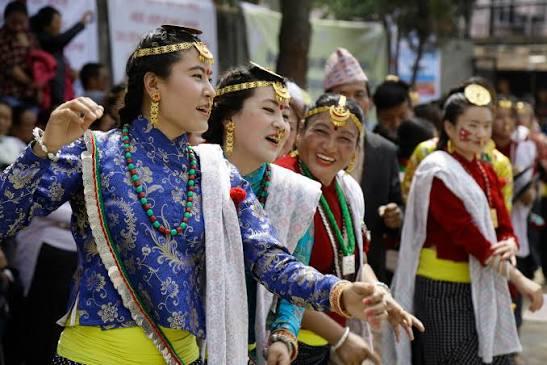
While they celebrate, you can witness many traditional attire, music, or dances. Women wear chhit ko guneu while listening to the rhythm of Dhol, Jhyamtha, and Baja, traditional instruments. Depending on the cast, the dance isn’t the same; for the Rai, it is the Sakela dance, and for the Limbu, it is the Chyabrung dance. Sakela are energetic dances where you bounce your feet at the rhythm of the music. Those performances occur in diverse historical places on the Eastern Hill, such as Diktel, Buipa, Rupakot, Jantedhunke, Tuwachung, and others.
Legend of Udhauli and Ubhauli
Many legends exist around Sakela, here is one of them. In Kirat mythology, Paruhang, the god of Kirat from heaven, fell in love with an earthling, Sumnima. They got married and had four children. One day, Paruhang left his family for a long time, leaving them in a hut on the riverbank of Dudhkoshi. Sumnima needed to get food for her children; as she was looking, she found a creeper and tasted it. While eating it, she felt power and happiness, so she brought it to her children and made buti (a garland). After she put it, the garland inspired people to speak the truth. After a while, Paruhang returned, his wife was angry, and after she showed him the buti, he told her the truth. He meditated on Mount Everest, looked at heaven and earth, and visited the universe. After explaining everything, he promised never to leave her again; she was so happy that she performed the dance of joy - Sakela. Since then, the Kirat Community has danced Sakela on Ubhauli and Udhauli.
Why celebrate Udhauli and Ubhauli
Udhauli and Ubhauli are festivals deeply connected with nature; participation in such festivals will allow you to reconnect with nature. Nature is a central part of our life that we tend to take for granted and forget to enjoy its beauty. Walking through nature sometimes feels like meditation. Moreover, it will be an opportunity to observe traditional celebrations, enjoying the music, the dances, and the clothes. Nepali festivals are always lively and full of colors. Ubhauli and Udhauli are an opportunity to learn about the roots of Kirat community, as they are part of the origins of the religion and culture.