



“Teej festival Nepal” is the term most people search, so it leads the URL. “Nagarkot homestay” tells Google the page also offers an experience, not just information. Leave out the year so you can update the page every season.
Teej is a festival celebrated by Hindu women all over Nepal. It takes place between mid-August or mid-September. The word Teej comes from a tiny red insect that appears around the monsoon period.
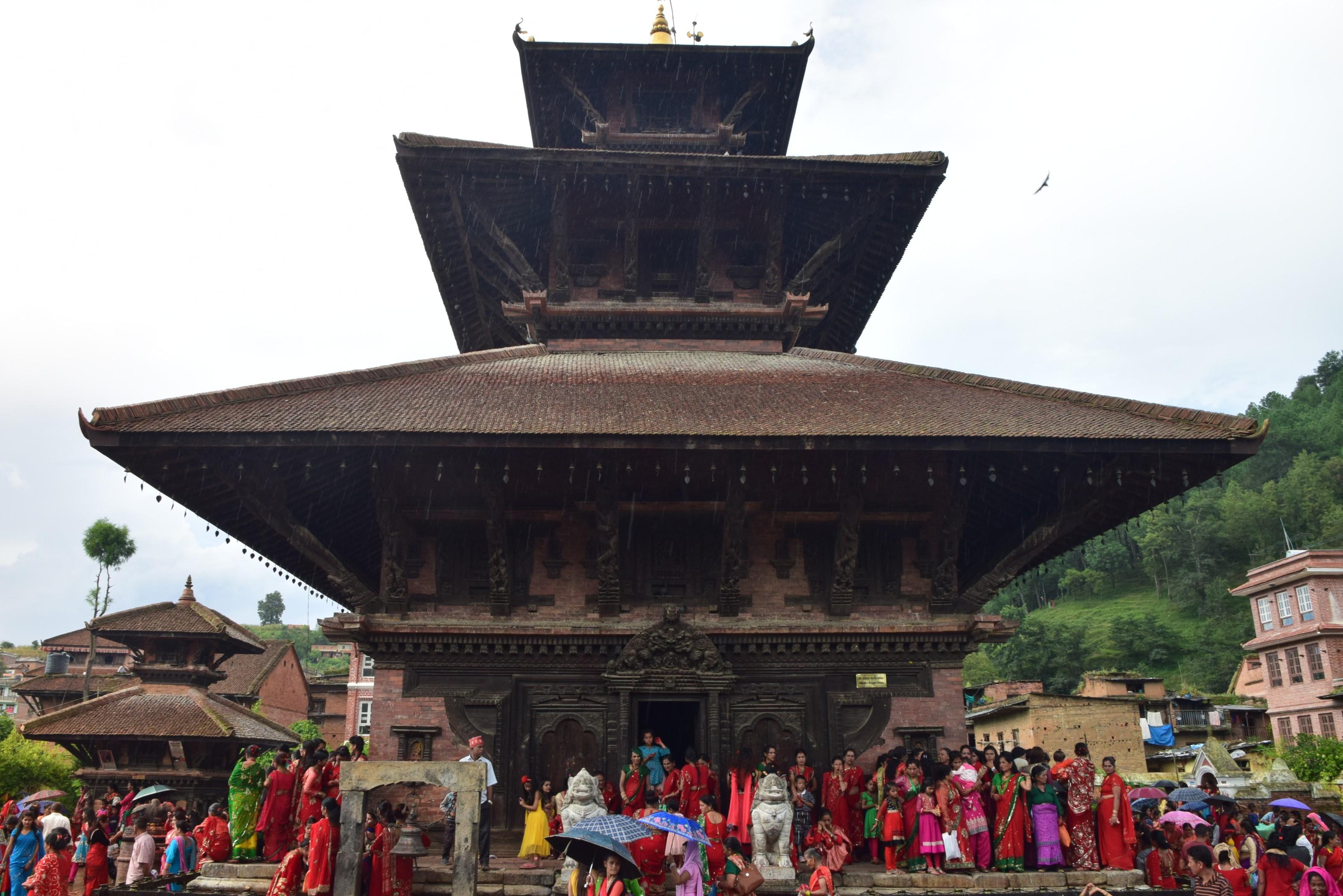
According to legends, Teej is a day dedicated to when Parvati became the wife of God Shiva. In the legend, Parvati flew away from her home because her father wanted her to marry Vishnu. She went into the forest and prayed to Shiva, asking him to become his wife. However, she could only marry him after her 108th birth. When she could finally be his spouse, Teej was celebrated in honor of Goddess Parvati, also called Goddess of Teej. So this festival is mainly known to be celebrated by married women for the well-being of their husbands or by unmarried women who pray in the hope of having a good husband in the future. However, in some communities, it is seen as the “festival of sisterhood.” On this day, numerous women gather to celebrate this festival together. Most of them wear red outfits, creating a beautiful red sea of people moving as one.
Teej is a three-day long festival; each day has a special ritual and celebrates a particular belief. These specific days are thoroughly performed, and Nepali people honor their god, Goddess Parvati, in the best way possible.
The first day is also called Dar Khane Din; on this day, women gather together and wear their best attire; they are beautifully dressed and have magnificent makeup and jewelry. In addition, they sing devotional songs and dance together. It's a meaningful moment that the women share, moving together and their voices mixing and offering a beautiful melody. Moreover, men host a giant feast; it is a day for women to take it easy. Dar Khane Din is the day when women can witness freedom; they don't work, don't do house chores, and they can express themselves however they want. They can spend time with their family and friends. For women, it is a memorable day; it is the occasion to take care of themselves and spend quality time with the people they love.
Moreover, nowadays, this day has been seen as an opportunity for women to express themselves and spread awareness about some conditions. It calls for respect and equality among all. Sometimes society is unfair, and on this day, women can speak out their thoughts. More recently, this first day of Teej is indeed a memorable day for women; however, in a way, it is not only about having fun but also a way of joining forces and showing independence and their importance to the world.
The second day is the fasting day. On this day, women have a rigid regime; some don’t even drink a drop of water; nonetheless, others do eat some fruits and drink. Unmarried women do this fasting in the hope of having a good husband in the future. Married women also fast, so their relationship with their husbands will be lifelong, even through death. They fast so their family and husband can have a peaceful and prosperous life. Here, we could say that women are like a portal between the spiritual world and our world as they ask to be in life and death with their husbands. In addition to fasting, the women dress beautifully, with red saris, as they dance towards Pashupatinath Temple. They honor Shiva by offering flowers, fruits, sweets, and coins. One of the most critical parts of the day occurs at nighttime when Puja is performed. They burn an oil lamp throughout the whole night. Once again, it is for prosperity.
The third day is called Rishi Panchami, is dedicated to the seven sages - Saptarishi. After the Puja of last night, they pray and worship the seven saints. To pray for them, as an act of purification, women take a bath of red mud on the roots of the Datiwan Bush (Holi tree). All married, unmarried women and girls having their first menstrual period participate in this bath; indeed, the first menstrual period is seen as impure. Furthermore, the fasting continued to ask forgiveness if they made any mistakes, mostly during their first periods; the seven saints would be the ones granting forgiveness. The fasting only finishes after Puja, so that it can take more than a day. When women can finally eat, they have karkalo ko tarkari with chokho ghee, which is seen as a pure dish.
As you can see, this festival is really centralized on women; the first part is very fruitful and attractive for them (Day one), as the second part has more “restrictions” (Days two and three). In fact, the fasting part about Teej has brought some questioning, indeed, why women should fast for their husbands. Some people see it as a sign that women are still seen as “inferior” to men. However, others would say it is a way of showing love and an essential part of their culture. With society growing and changing, some aspects are seen differently than before, and more people have changed their point of view on this festival. It is a bit controversial; on the first day, they can express themselves, spread awareness, and discuss important topics that touch them deeply. Yet, on the second day, they fast for their husband and family, and on the third one, the first menstruation period is seen as impure. However, some people are still attached to the tradition and point out that these days are for dancing, singing, praying, worshiping, fasting, and reuniting with friends and family. Some people miss the simplicity of Teej, even though they admire women breaking the conventions. We encounter mixed feelings about the ones wanting to demonstrate and express themselves and those missing the initial celebration of Teej.
Nagarkot is also a little village at 30 kilometers from Kathmandu; it is known for the beautiful views of 8 out of 13 Himalayas ranges of Nepal. It is a small town perfect for nature lovers and people who enjoy hikes or taking things slow while enjoying life's horizons and simple pleasures.
Celebrating Teej in this little town would be a great experience, because it is small, practically everyone knows everyone; it creates a reassuring and pleasurable atmosphere. It is about sharing a special moment with all the women of the village and a great opportunity to learn to know them in a light atmosphere where everyone is enjoying themselves. Teej here is celebrated by the female host of the homestays and is celebrated for 2-3 days.

Experience Teej Festival Nepal: Legend, Rituals & Traditions not as a spectator, but as a part of the family. Stay with local hosts, join their celebrations and experience the true spirit of Nepal.